Amazon Add-on experience
Highly relevant accessories, effortless to choose and buy.
- Role
- Company
- Marketplace
- Year
01Overview
One order. Everything the device needs.
Customers shopping for devices on Amazon.in can now discover and buy the must-have and good-to-have accessories and services in the same order, at a discount, the way they would walking out of an offline store fully set up.
The accessories and services are curated to meet product compatibility requirements as well as customer needs like higher-rated products, faster delivery, Prime eligibility and single-stop fulfilment.
Customers can feel confident while making an accessory purchase and don't have to go through a choice overload.
02Customer problem
Post the buying decision, customers immediately want what makes the device usable.
After committing to an electronic device, customers immediately want to buy related accessories and services that are critical for product usage and protection.
Today on Amazon that decision is hard. Customers sift through a huge selection, over 10 crore accessory products listed on the website, to narrow their consideration set around compatibility, product quality and their delivery expectation.
03The gap today
Where is the gap in the current experience?
In offline stores customers usually buy the related accessories with the product. These critical accessories are essential for the product experience, so they get all of them together. Over and above this they get a bundled discount based on their bargaining ability.
That discount is inconsistent, but the expectation has stuck: consumers now expect a bundled discount online too, which we currently lack.
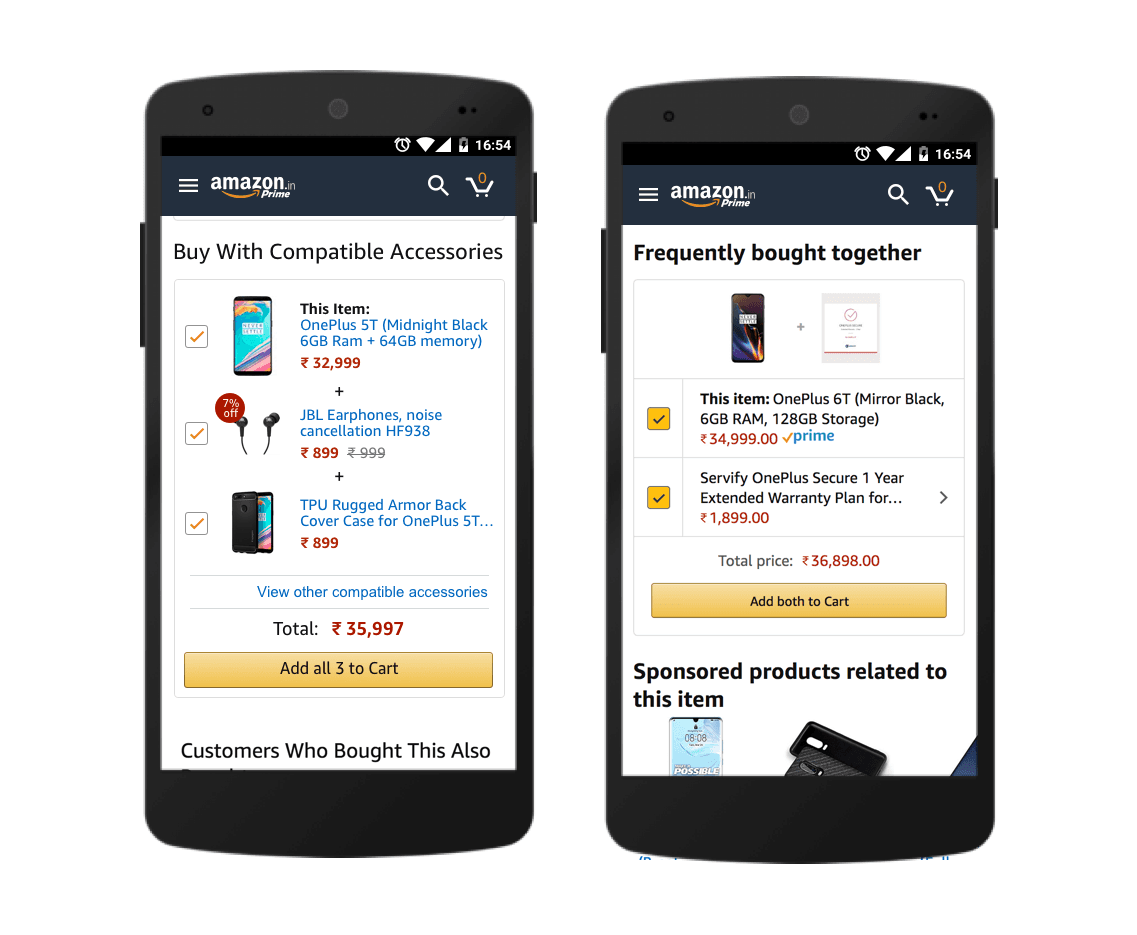
Today accessory discovery at multiple places is intrusive, customers get exposed to unrelated accessory items at an early stage, even before firming up their device choice, breaking their comprehension flow while they are still trying to understand the device.
04Why solve this
Why is this an important problem to solve?
Accessory and service attach rates for India High-Consideration categories are very low, both same-order attach and 15-day attach, compared with offline.
05Customer research
What did the customer say?
End-to-end customer research studies for High-Consideration technical product categories highlighted customer frustration related to the attach experience. A few customer quotes below.
When you buy a phone offline you leave the store with everything working, data transfer done, phone customised. Stores stock multiple accessories, so you can pick up a cover, case, headphones, storage, anything you need, and they have spare parts for any problem. When you leave the store, you leave with a functioning phone and a sense of security.
In their words
Three frustrations we heard again and again
The Frequently Bought Together / Customers Also Bought widgets “up-sell” customers before they've had a chance to deeply evaluate a product.
Customers frustrated by difficulty finding compatible / related items did not trust ASINs in the “Customers also bought” widget.
Bundling widgets such as Frequently Bought Together / Complete the Look do not provide volume discounts, contrary to customer expectations. Customers are disappointed when they do the math only to discover there's no discount.
06Decision factors
Key factors which customers consider while making an accessory purchase
When a customer weighs an accessory on the detail page, four signals do most of the work.
Badge
Trust markers like Amazon's Choice and Prime that signal a safe, recommended pick.
Price
The price and any savings, weighed against the device already in the cart.
Rating
Star ratings and review counts that vouch for the accessory's quality.
Delivery speed / COD availability
How fast it arrives and whether cash on delivery is on the table.
07Synthesis
Reasons for low attach rates
Eight recurring reasons, drawn together from the research and the current experience.
08Early concepts
It was clear that, if a customer buys accessories and services from Amazon, they should discover compatible accessories at the right point in their purchase journey and recognise the experience to be rewarding.
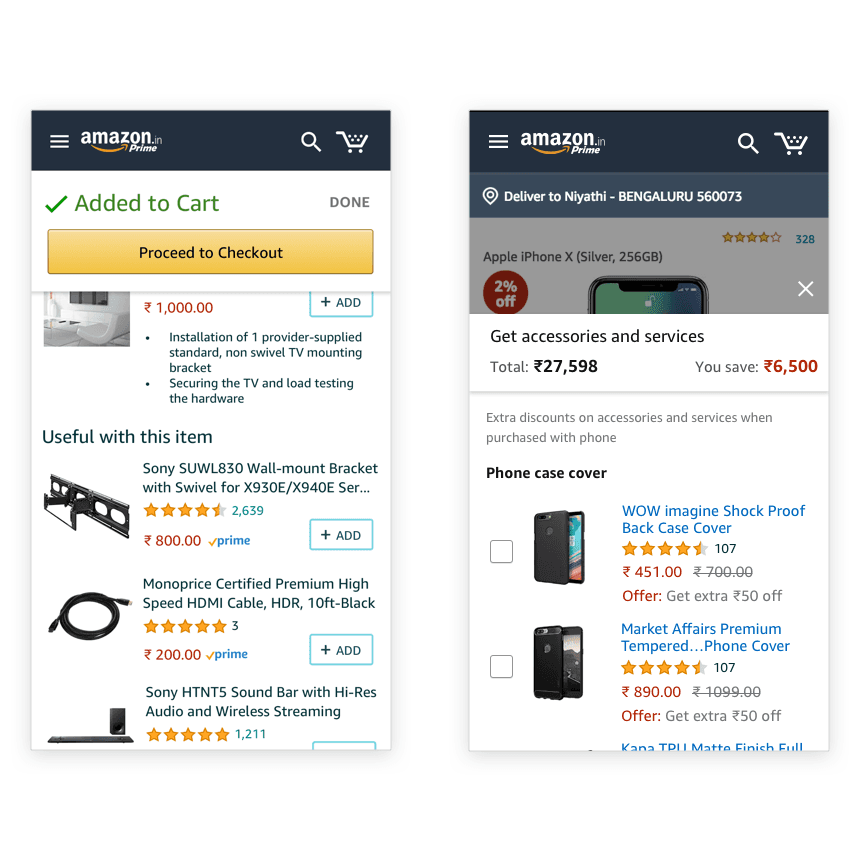
From today's scattered cross-sell to a single, rewarding “get accessories and services” moment.
09Phase 1 experience
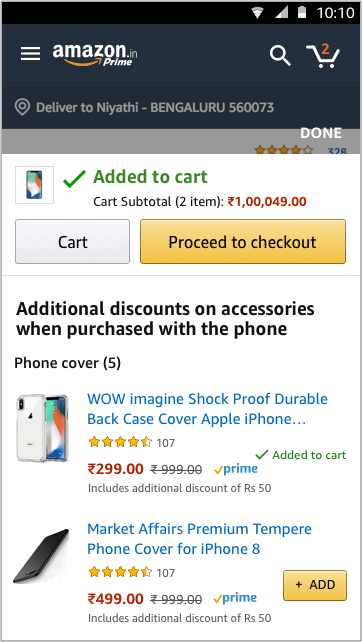
Right selection
To solve for the right selection, we proposed leveraging a new algorithm, a Dynamic Cart builder that allows up-sell on an item-over-item or offer-over-offer basis.
Right point of discovery
The experience was built as a post “Add to Cart” flow, so the customer's device-comprehension flow on the detail page doesn't get interrupted. We didn't want to put the burden of up-sell on customers looking to buy immediately through “Buy Now”, and the split of Buy Now vs Add to Cart for HCTP is almost equal between the two CTAs.
10Launch
Phase 1 launch experience
Phase 1 of the HCTP attach experience launched in Amazon India in Q1 2023 and significantly improved same-order attach rates. To see it live: browse for a mobile, laptop, tablet, camera or printer, open the detail page and hit “Add to Cart”, and the attach experience appears as a bottom sheet.
The launched flow: device buy box → add-to-cart attach → curated covers → scrolled selection → accessory mini detail page.
11Impact
Metrics that I improved with this experience.
The attach experience performed incredibly well compared with other global attach experiences across geographies. Appreciation from the Kindle team was incredible. At one point we were looking at achieving their conversion rates.
Percentage increase in conversion for each category
This is a superb accessory experience. I've tried it and it's pretty seamless on mobile. It's better than any other purchase experience because it doesn't occupy real-estate before “Add to Cart” is clicked and surfaces the right selection only then. Consumer Electronics considers this solution to be on-par with virtual bundling.
12Next steps
Phase 2 and next steps
Phase 2 experience (live)
Phase 2 of the attach experience was experimented with before Diwali and went live during Diwali, with a significant increase in attach adoption.
In Phase 2, we re-looked at the additional-discount communication on the current experience, surfaced as a customer frustration in HCTP customer research. Phase 2 is live in the Amazon app and mobile browser.
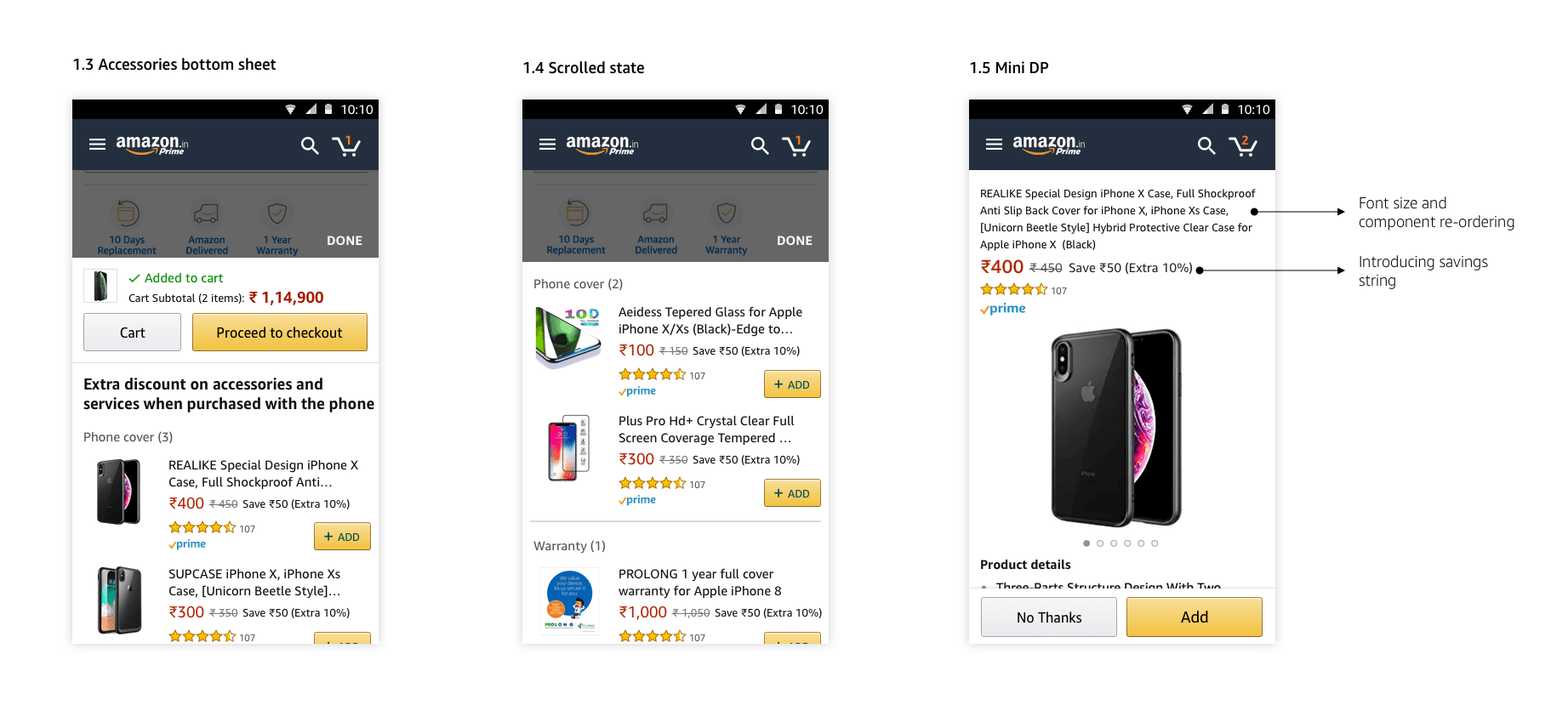
Phase 2 experience (live). Refining the discount communication: introducing the savings string and re-ordering components across the bottom sheet, scrolled state and mini detail page.
13Reflection
What I learned from this project
This was my first launch at Amazon after joining the team. Proud to have been part of such a motivated group of people. I learnt a great deal working on this project.
The attach experience had no precedent when we started, but we knew where we were going and believed in the mission. We believed the prize for customers was big enough that it was worth going the extra mile. Not everything proposed was achievable in the first flight, and the team had to incrementally move forward despite setbacks, which resulted in a successful launch.
If your mission is clear, your sense of ownership will find you and guide you.